
Huntington County Court Records After Arrest
After a Huntington County jail arrest, the booking record is created at the jail and the court record begins when the prosecuting attorney files or pursues charges. Indiana uses county prosecuting attorneys rather than district attorneys. The Huntington County Prosecuting Attorney represents the State of Indiana in criminal prosecutions for county offenses, and IPAC identifies Jeremy Nix as Huntington County Prosecuting Attorney. Once charges are filed, the public case path runs through Indiana MyCase and the local court or clerk for copies not available online.
A jail profile may list booking charges, arrest date, bond, and custody status. Those records are useful, but they are not the final court record. Booking charges can be declined, amended, reduced, dismissed, or replaced by charges in a complaint, information, or indictment. Custody and booking details belong with Huntington County jail inmate records; booking photos belong with Huntington County jail mugshots. The court record is the case file path for charges, hearings, events, bonds, dispositions, and sentencing.
Find Court Records After Arrest
The official Indiana Judicial Branch Huntington County page links users to court case search and says to contact the local court for jury duty, court dates, or copies of case documents that are not online. Indiana MyCase is the main public case-search portal for criminal charges after a Huntington County arrest.
- Start with the jail roster or VINE only if the goal is to confirm custody and booking identity.
- Open MyCase and search by defendant name or known case number.
- Narrow by Huntington County, criminal case category, filed date, or case status when filters are available.
- Open the case and compare court-filed charges with booking charges.
- Review hearings, case events, bond records, disposition entries, and document links if public.
- Contact the Huntington County court or clerk for copies that MyCase does not provide.
The official MyCase portal is shown below as the court-record search point for Huntington County charges after a jail arrest.
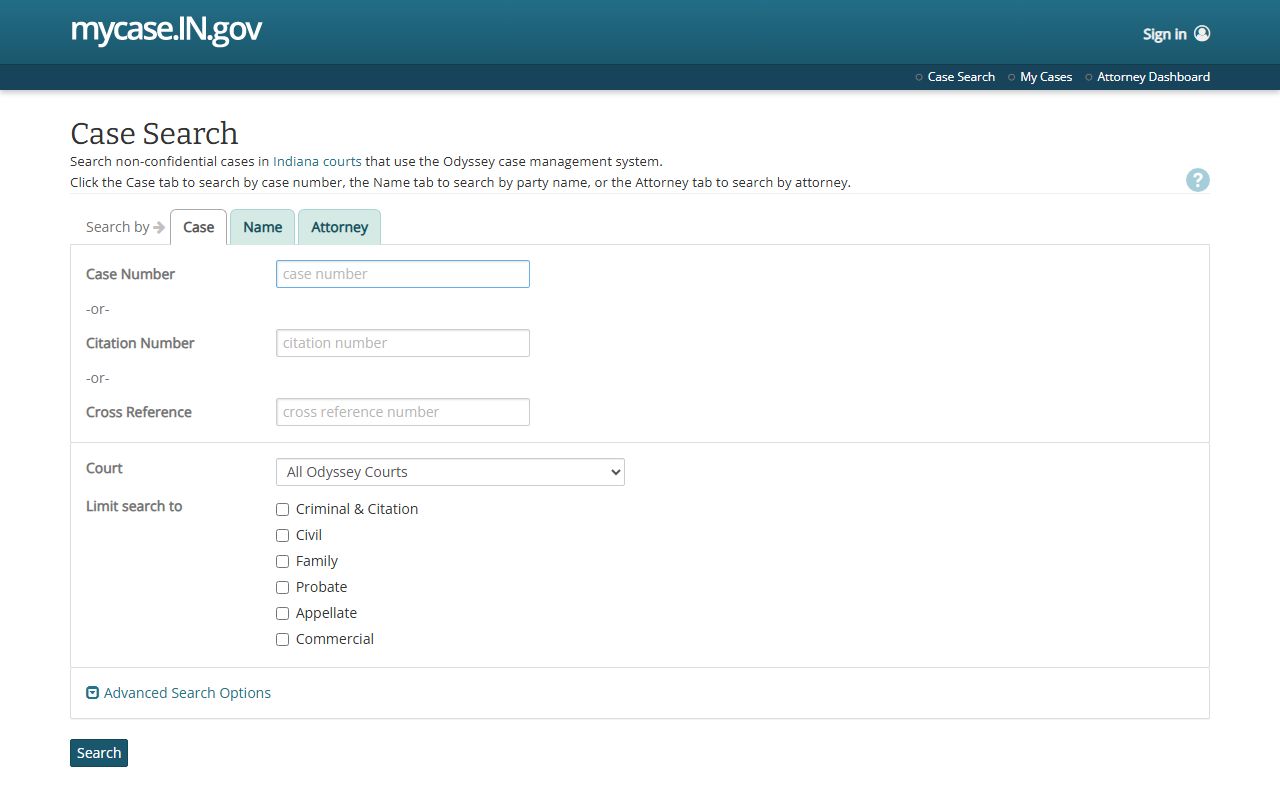
MyCase is a case index and document portal. It does not replace direct court contact for certified copies or records that are not posted online.
Huntington County Court Search Fields
MyCase supports more than a name search. For a recent arrest, use the defendant name first, then narrow by filed date near the booking date. If a case does not appear, the prosecutor may not have filed yet, the person may be listed under a different spelling, or the arrest may involve another county's warrant.
| Field Label | Type | Use | Notes |
|---|---|---|---|
| Case Number | Text | Known case lookup | Best when a court number is already known |
| Citation Number | Text | Traffic or citation-linked matter | Not every jail arrest has a citation number |
| Party Name | Text fields | Defendant search | Use the name from the jail booking, then try variants |
| Court / Location | Dropdown | County filter | Select Huntington County or court location if available |
| Case Type / Category | Filter | Criminal cases | Helps remove civil or traffic-only noise |
| Filed Date | Date range | Recent arrest timing | Case filing date can differ from booking date |
| Status | Filter | Open or closed cases | Useful for pending versus disposed charges |
Charging Documents After Arrest
The arrest-to-court path starts with a law-enforcement event and jail booking, then moves to prosecutorial review. The prosecutor reviews reports and probable-cause material and decides what formal charges to file. The sheriff records page has a local routing rule: if a report was sent to the Prosecutor's Office for criminal charges, the requestor should contact the prosecutor for that report.
| Document | Plain-English Role | Why It Matters |
|---|---|---|
| Complaint | Initial charging or probable-cause filing | May start the case after arrest in many criminal matters |
| Information | Prosecutor-filed formal charge | Common path for Indiana felony and misdemeanor prosecution |
| Indictment | Grand-jury charging document | Less common in routine county arrests, but still a formal charge path |
Huntington County Charge Status
Charges can change after the first court filing. A charge can be added, amended, reduced, dismissed, or resolved by plea, trial, diversion, or other disposition. MyCase charge data can include offense date, statute, offense degree, offense modification, and original offense degree. The offense date is not always the booking date.
| Status | What It Means |
|---|---|
| Pending | The case or charge is open and no final disposition has been entered. |
| Amended / Reduced | The prosecutor or court changed the charge, degree, or wording during the case. |
| Dismissed | The charge was ended without a conviction on that charge. |
| Nolle Prosequi | The prosecutor chose not to continue that charge, subject to court procedure. |
| Disposed | The charge has a recorded outcome, such as conviction, dismissal, or other final action. |
Bond Records After Jail Arrest
Bond can appear in both the jail and court record. The official Huntington County bond page explains local payment rules: cash bonds and 10% cash bonds must be paid by cashier's check or money order payable to the Clerk of the Courts, or by credit card through GovPay. The jail does not accept cash bond payments. GovPay uses location code 5098, and surety bonds use registered bondsmen, who usually charge a nonrefundable 10% fee according to the county page.
| Bond Type | How It Works in Huntington County |
|---|---|
| Cash Bond | Full amount paid to the Clerk of the Courts by approved method. |
| 10% Cash Bond | Ten percent is paid and held by the Clerk until the case ends, subject to deductions. |
| Surety Bond | A registered bondsman posts the surety; jail staff cannot recommend a bondsman. |
| Split Bond | The judge orders both a 10% cash and surety component. |
| Own Recognizance | Release by court order on promise to appear. |
| No-Bond or Hold | A warrant, detainer, DOC hold, ICE hold, or court order can prevent release. |
The official Huntington County bond information page lists the local bond types and payment restrictions.
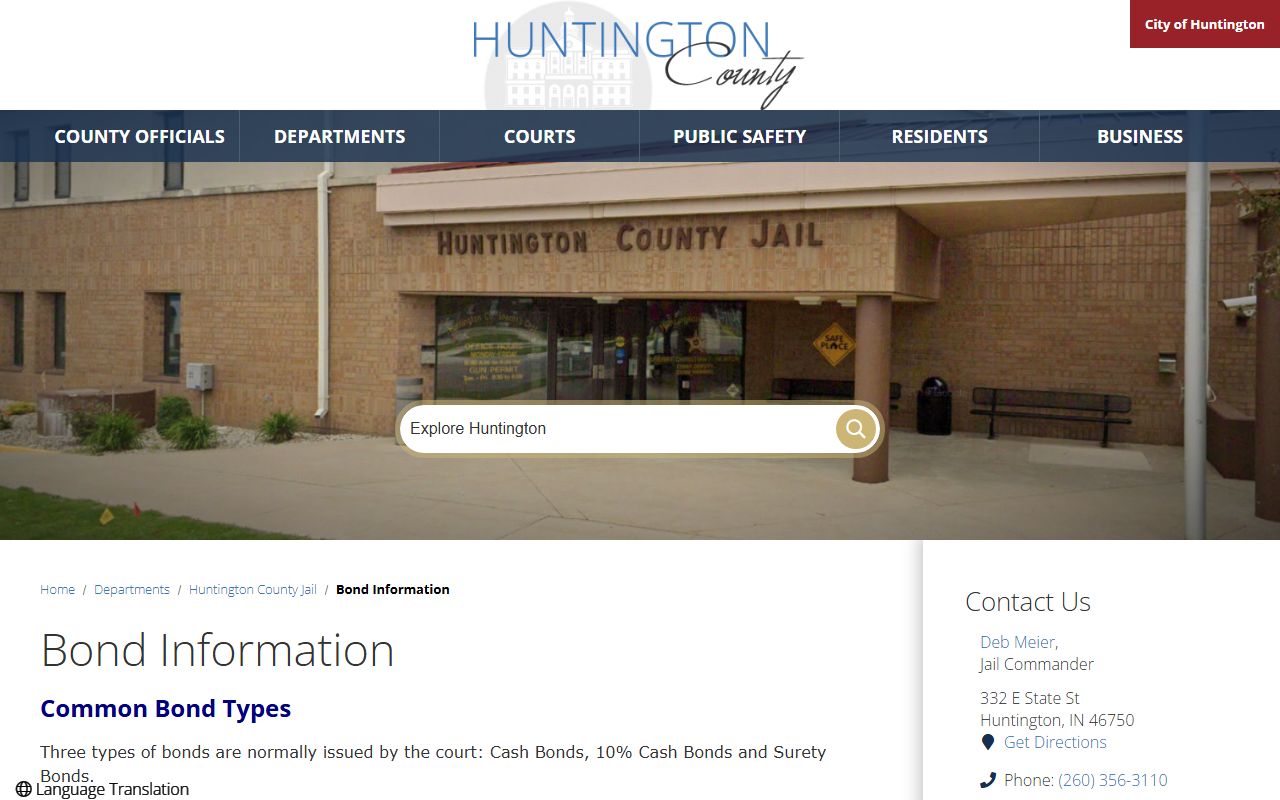
Verify bond amount and release conditions with the jail, Clerk, or court because online case data may lag payment or hold changes.
Warrants Before a Court Record
No official Huntington County criminal warrant search page was located in the sheriff topics inspected. A warrant can still matter after a jail arrest because MyCase can show active warrant counts in party details and the jail profile can show holds. A tax warrant topic in sheriff navigation is not the same as a criminal arrest or bench warrant list.
For warrant-related custody, check MyCase by defendant name or case number, then call the jail station if the person may have been booked. If the warrant was issued by another county or state, Huntington County may only be the holding location while the issuing agency acts. Do not rely on third-party warrant lists for surrender, bond, or safety decisions.
Charges vs Convictions
A charge is an accusation. A conviction is a final result after plea, trial, or other qualifying disposition. The sheriff's local criminal-history page warns that Huntington County checks include verified arrest and booking information only and should not be used to determine a person's actual criminal record. It also says local checks do not reflect court charging decisions or trial outcomes.
| Question | Charge | Conviction |
|---|---|---|
| Stage | Filed accusation after arrest or investigation | Final court outcome on a charge |
| Proof level | Probable cause or formal filing standard | Guilty plea, verdict, or qualifying adjudication |
| Where searched | MyCase charge list and events | MyCase disposition, judgment, sentencing, or certified court records |
Sealed and Expunged Arrest Records
Indiana expungement law can limit public access to qualifying arrest or charge records. Research identified IC 35-38-9-1 as the arrest-record expungement route for qualifying cases that did not result in conviction or were vacated, subject to timing and a court order. MyCase can flag or hide expunged cases, so absence from public search does not always mean no event ever occurred.
| Issue | Sealed | Expunged |
|---|---|---|
| Public visibility | Hidden or restricted from public view by court rule or order | Limited by Indiana expungement order and statutory rules |
| Who acts | Court or record custodian | Court order under Indiana expungement law |
| Online result | May not appear publicly | May be flagged, restricted, or removed from public display |
Background Check Limits
Casual court and jail searches are not the same as FCRA-compliant background checks. The sheriff's local check is limited to verified Huntington County arrest and booking information, and the county points users to Indiana State Police for more extensive criminal-history checks. Employers, landlords, lenders, insurers, and licensing bodies need lawful screening processes rather than a jail roster or informal court search.
Important: Do not use jail, roster, or court-search information for any FCRA-covered screening decision.
Restricted Court Records After Arrest
Some court and arrest information can be restricted. Indiana APRA exceptions include confidential and discretionary categories, and investigatory material may be withheld or redacted. Juvenile matters, sealed cases, expunged records, active investigations, and protected personal information can also be unavailable in public search. For certified dispositions, copies, or records not posted online, contact the court that maintains the record rather than relying on a jail booking entry.